Jeanine {right} oyster planting, with her crew, Billie, on a grueling hot August day, on Corrigan’s Reef in the Gulf of Mexico . Jeanine’s father had died harvesting oysters on this reef, when she was only ten months old, but, she said “Although he wasn’t in her life to influence her, she would still have been drawn to follow in his footsteps by making a living – working on the Gulf of Mexico.”
In 1986 I did a story for SAILING Magazine, featuring my Drascombe Dabber and Cathy Dean, a model from Gainesville, Florida who had volunteered to be part of the story, in 2019 I posted the B&W photos from that article on this blog.
Here they are again, this time published as a ‘1 Signature’ Zine, printed on 9×12 inch Strathmore Drawing paper.
The Dabber is a fantastic small, open, British sailboat. I imported it while living in Hawaii. We brought it back to the mainland, and I towed it across the country, sailing in New England, North Carolina, and Florida.
Can’t believe it took me this long,if you can, please do use it, it greatly improves my morale and sure makes for a more rewarding blog environment. As a silly aside, I love seeing the various avatars!😊
A new ‘1Signature’ zine using blur portraits of my friend https://milindachristiansen.wordpress.com/. I want to pause right here and show one of the zillion ways I manage to mess up even doing a simple zine. See the prominent ‘1’ over the arm and knee in the left photo/page above. That is because I neglected to hide the layout layer in Photoshop and didn’t notice it till I had printed and assembled the first proof. There are a couple more glitches in this proof, but none as glaring as this one. So, instead of being able to stick this in the mail, I had to make another copy.
Buried in my closet were, among other things, these cyanotype portraits. All are from 35mm film negatives, the last two are pinhole portraits. For my SLR I converted the body cap into a pinhole arpeture and thus could switch from pinhole to lens photos in the middle of a roll. To make Cyanotype prints bigger than 35 mm, I made digital negatives of the desired size. One nice aspect of making digital negatives is that text and graphics can be added to the image.
The photos for this Zine are from a relatively short photo session with Teresa. I am again struck by how meaningful photos become ‘pulled together’ thus in a zine/publication as opposed to ‘stand-alone’ prints.This ‘OneSignature’ zine is again printed on 9×12 Strathmore Drawing paper.
Still fine-tuning/ ‘putzing around’ with my ‘WaterWomen’ zines. Although these are only ‘One Signature’ zines [one sheet of 9×12 Strathmore Drawing Paper] I had to print three proofs of April’s to get an error-free signature, mistakes were from misaligned text to leftover editing marks.
April:
“I helped my father with shark fishing and crabbing when I was young.
After the net ban, he taught me clamming, then dropped me off out in the water on a lease.
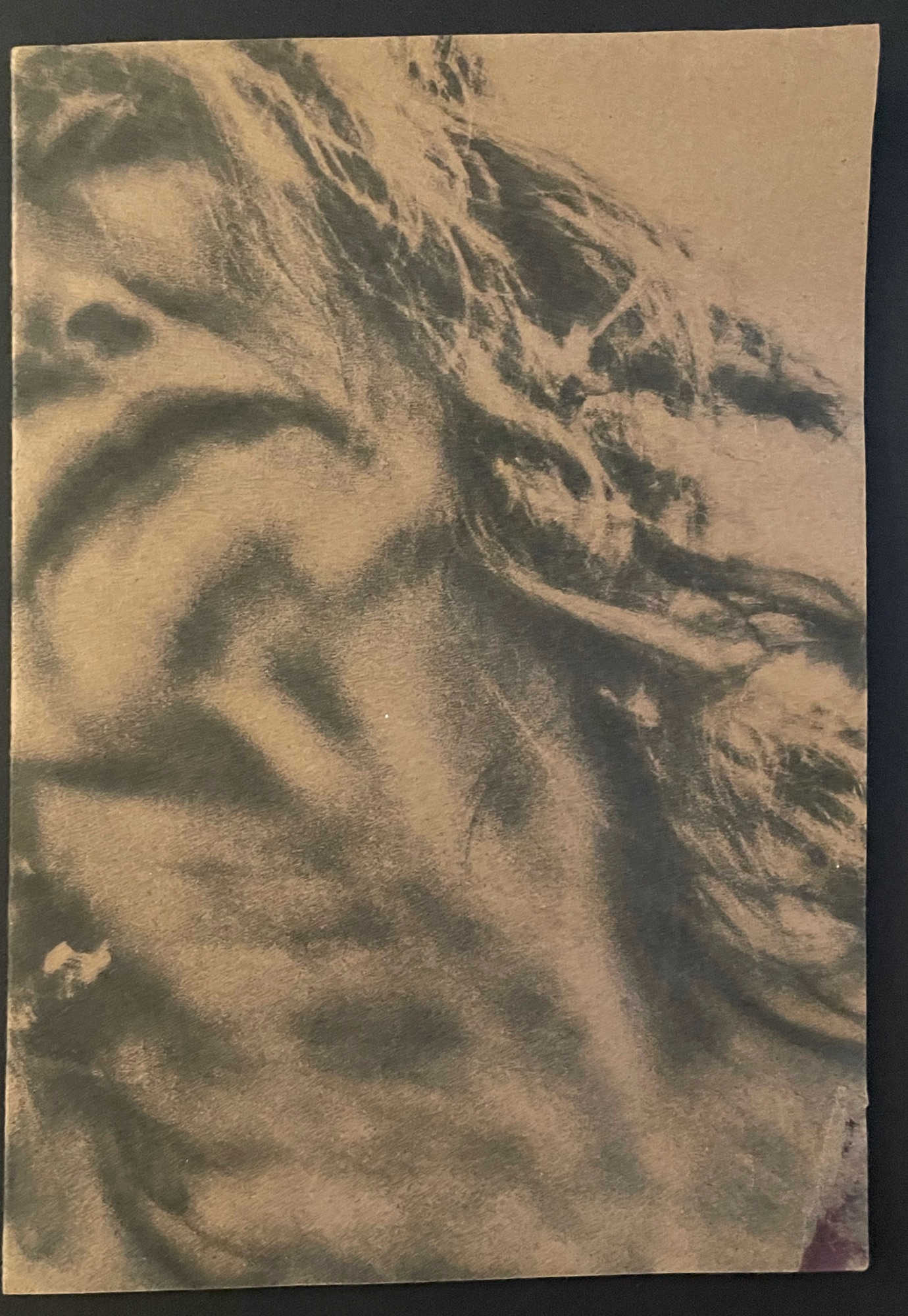
When I had my first wide-body Epson printer I went through a period of printing on Kraft Paper, and other weird non inkjet papers.
One of the things I did was make a Zine with some of the nudes I had done with a friend.
It turned out pretty neat, but different, and I wasn’t really sure how I felt about it.
One funny result was that when a friend and I went to an area Community College to show some of my documentary work and see if they would give me a show, my friend had had one there, and was introducing me, they saw the Zine, and I am sure it was what ‘torpedoed’ me because I didn’t get a show, and they loved my documentary work.
So I remained unsure of the work till a friend, a prominent West Coast photographer, to whom I had sent a copy, gave me the below feed-back.
I had totally forgotten about her wonderful comments till I unexpectedly rediscovered them, a couple of days ago, they made my week!
“This Kraft Paper Zine took my breath away. Really, I forgot to breathe when I saw it. It tells such a story and the compliment to you there is that I don’t know what the story is, and it’s not important. It’s lyrical; it celebrates Woman in all her moods and realities. It’s evocative too, an over-used word but I mean magical and touches me very much. I have the feeling I GET you much deeper and betterthan before. And in a way it takes me back to the Rilke poem you had illustrated when I first met. It impacted me square between the eyebrows too.
I’d like to see the Kraft Paper be a little lighter BUT then what you really want to say with this darkness might need the viewer to work for it in this darkness, to pause awhile and put out the effort to see into it, to meet it halfway like a good poem. A good poem insists that I meet it and doesn’t care if I don’t bother to participate in it because it stands in its dignity as is and doesn’t budge and compromise and insist on being easily seen with plenty of contrast and all nice tonalities. Your images are captured or processed in order to reveal only so much and leave the women to the privacy and secrecy of that which they don’t overtly want to reveal, but only wish to merely point at. The body language says a lot and one thing is: “he didn’t ask me to disrobe totally unless I wanted it that way. He let my organism determine what I wanted to do” (and that naturalness is part of the “rightness” going on here.)
It seems the nature of these is to touch the viewer emotionally without filling in all the dots and without being a left-brain-conceptualizer. Es fehlt etwas, {something is missing} and that already is what makes it about allgemeine [universal] Woman and less specific or literal than a particular woman. Some seem like a particular woman portraying “Woman” very well
I am VERY honored to possess these, and this is such an exquisitely magical piece of art. I am not sure precisely what I am saying and that is OK: I really GET what you are doing!!!! Oh, and the whole is much bigger than the individual parts-that’s another thing I realized last night.
I believe that nudes are a special category. Faces with nudes, faces alone in the company of nudes. Because: the viewer has a naked body under his/her clothes and when we see a body tortured into an awkward or painful pose- we hurt and cringe a little just viewing it, and when we see a very natural moment of uncontrived beauty with a regular person (not a fashion model, ‘Puppe’), our naked organism breathes out and says in a loud whisper YES!!!!
This book will be calling me back again and again to view and experience it – it is solidly in the category of subtle work which only gets better on further deeper viewings. The effort the viewer makes to grasp
the Kraft Paper version – really draws the viewer in, as I mentioned, and will keep me coming back too,
because it calls for my intense involvement and it’s so effective in the way it communicates the magical “isness” therein. The viewer-experience can also be described as an all-encompassing meditative state. Obviously, for good reason, words are clumsy in terms of speaking about your fantastic gift (and your creative gifts.)”
This ‘showed up’ on my phone this morning, and it’s a good reminder that it’s time to put together and publish another Zine.
It surprised me how good some color photos work on the Strathmore paper. The subtleness of the colors on the warm drawing paper compliments the image rather than degrading it.
I continue to be drawn to blurry and out of focus photos. These are film photos from my archive. Perhaps my increased appreciation of them is connected to my deteriorating eye sight, who knows?




 christian harkness - photo blog